

How to Identify Heat Treated Crystals
Table of Contents
- What Is Heat Treatment and Why Gemstones Are Heated
- How to Identify Heat Treated Crystals: Visual Inspection Basics
- Using a Jeweler's Loupe for Magnification
- How to Tell If Citrine Is Heat Treated
- Identifying Dyed vs. Natural Crystals
- Are Heat Treated Crystals Less Effective for Your Practice
- DIY Testing vs. Professional Gemological Analysis
- Heated vs. Unheated Gemstones: What Lab Certification Reveals
- Frequently Asked Questions
Last Updated: September 23, 2026
What Is Heat Treatment and Why Gemstones Are Heated
Heat treatment applies controlled temperature to gemstones to intensify color, improve clarity, or create visual effects that increase marketability.
Gemstones are heated to increase perceived value, pale citrine becomes deep golden, cloudy quartz clears. The problem: heat treatment fundamentally alters the crystal's natural state, yet most sellers don't disclose it.
At MyLee Moon Blessings, we believe transparency matters. When you're selecting crystals for your spiritual practice, you deserve to know whether you're buying a natural stone or one that's been artificially enhanced.
Citrine, amethyst, tanzanite, and topaz are most commonly heated. Some treatments are permanent; others fade with light or temperature exposure. Understanding this distinction helps you choose stones aligned with your practice.
How to Identify Heat Treated Crystals: Visual Inspection Basics
To identify heat treated crystals, develop your eye for color and pattern changes. Heat treatment creates specific visual signatures distinct from natural formation.
Examine the crystal under normal light, observing color saturation and distribution. Natural crystals develop color slowly over millions of years; heat-treated stones show rushed color changes by comparison.
Color saturation and uniformity
Check whether color looks too uniform. Natural stones show color zoning, darker and lighter areas, which is normal. Heat-treated stones often display unnaturally even color distribution.
Heat-treated stones glow with uniform intensity throughout. Natural citrine shows color concentrated at the tips, with lighter areas near the base.
Watch for color that looks "cooked", a slightly orange or reddish undertone that appears flat rather than dimensional.
Heat halos and color zoning patterns
Heat halos, lighter-colored rings around the crystal's edges, especially near the base, are one of the most reliable indicators of artificial treatment.
Natural color zoning transitions gradually; heat-induced zones create sharp boundaries where heated and unheated portions meet.
Rotate the crystal under light, looking for color that appears "painted on" rather than grown naturally, heat treatment often sits on the surface rather than penetrating the structure.
Using a Jeweler's Loupe for Magnification
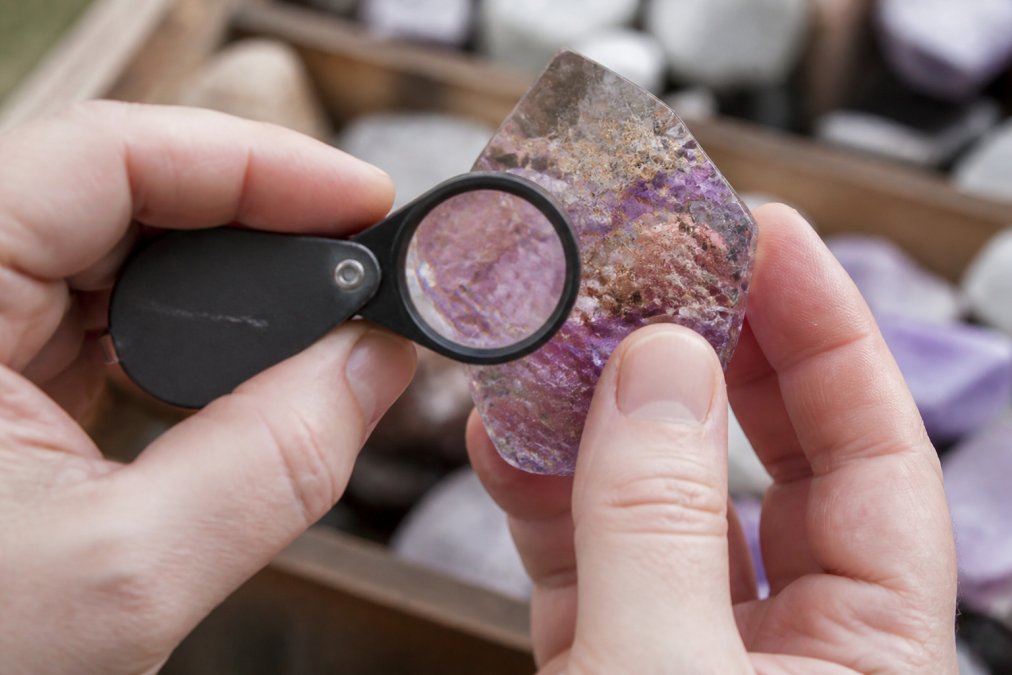
A jeweler's loupe (10x magnification, $10-30) reveals details invisible to the naked eye and is essential for serious crystal identification.
Hold the loupe close to your eye and bring the crystal into focus. Look at internal structure and surface features indicating heat treatment.
What to look for under magnification
Under magnification, heat-treated crystals show fractures radiating from the center in spiderweb patterns, caused by rapid temperature changes during treatment.
Natural inclusions appear organic and random; heat-induced fractures have geometric quality, straight lines or branching patterns, absent in naturally formed crystals.
Examine the crystal lattice structure. Natural crystals show consistent geometric patterns; heat-treated stones show disrupted patterns where temperature altered internal organization.
Identifying heat-induced fractures and internal inclusions
Heat-induced fractures radiate from a central point like cracks from pressure; natural fractures follow existing weakness lines in the crystal structure.
Natural inclusions (minerals, gas bubbles, liquid pockets) are random and scattered. Heat treatment can modify or eliminate inclusions, creating unnatural clarity.
Look for areas where inclusions have been partially dissolved or altered. This indicates thermal stress. The crystal's internal environment changed rapidly, affecting what's trapped inside.
How to Tell If Citrine Is Heat Treated
Citrine is the most commonly heat-treated crystal. Natural citrine is rare; most golden-yellow citrine sold has been heated from pale amethyst or clear quartz.
Natural citrine shows color concentrated at the tips with gentle gradation toward the lighter base, following the growth pattern.
Heat-treated citrine displays uniform golden color throughout, looking painted on with an artificial orange or reddish undertone.
Under magnification, natural citrine shows a smoky or cloudy base where color begins; heat-treated citrine has a sharp boundary line, the heating signature.
Identifying Dyed vs. Natural Crystals
Dyed crystals differ from heat-treated ones: dyes sit on the surface or in fractures, while heat treatment alters the internal structure.
Dyed crystals show color concentrated in fractures or surface areas. Dyed stones may feel sticky or transfer color to your hands.
Under magnification, dyed crystals show color concentrated in fractures; natural color saturation is consistent throughout.
Dyed crystals fade faster than heat-treated ones. Fading over years suggests dyeing; heat-treated colors are generally permanent unless exposed to extreme conditions.
Are Heat Treated Crystals Less Effective for Your Practice
The answer depends on your beliefs about crystal function and whether you trust the seller's honesty about treatment.
The energetic effectiveness debate
Many practitioners report heat-treated crystals feel muted or less responsive than natural stones; others notice no difference.
Heat treatment disrupts the mineral's molecular organization. If crystals work through geometric structure and energetic properties, this disruption theoretically matters.
Test both heat-treated and natural stones in identical conditions and notice the difference. Many practitioners find natural crystals produce stronger effects; others find the difference negligible.
The transparency and disclosure problem
What matters most is knowing what you're buying. Industry standards require disclosure of all treatments, heat treatment, dyeing, fracture filling, and other enhancements.
However, enforcement is weak in the crystal market.
Industry standards for disclosure:
A buyer's checklist for ethical purchasing
Before purchasing, verify seller transparency: (1) Check if treatment status is disclosed; ask directly if not. (2) Ask how they verify natural claims. (3) Look for gemological certifications. (4) Compare pricing, heat-treated citrine is cheaper. (5) Research seller reputation and customer reviews. (6) Confirm return policies for mismatched descriptions.
The real question: Informed choice
Whether heat-treated crystals are less effective matters less than knowing what you're buying. A consciously chosen treated stone may serve your practice perfectly; a misrepresented stone is a betrayal of trust.
DIY Testing vs. Professional Gemological Analysis
You can learn how to identify heat treated crystals using visual inspection and a jeweler's loupe, but understanding the limits of home testing is equally important. Many practitioners waste time trying to definitively prove heat treatment at home when the signs are genuinely ambiguous, and that's where professional analysis becomes essential.
What you can reliably detect at home
With a 10x jeweler's loupe and careful observation, you can identify heat treatment in approximately 70-80% of cases, particularly with commonly treated stones like citrine and amethyst. Specifically, you can:
- Spot obvious color uniformity that contradicts natural zoning patterns
- Detect heat halos and sharp color boundaries near the base or termination
- Identify heat-induced fractures that radiate from a central point in a geometric pattern
- Recognize dye concentration in surface fractures versus internal saturation
- Compare side-by-side with known natural specimens to calibrate your eye
What you cannot determine at home
Certain heat treatments are subtle or invisible to the naked eye, even under magnification. You cannot definitively diagnose:
- Low-temperature treatments that enhance color without creating visible fractures or halos
- Irradiation (a form of treatment that shifts color by altering the crystal lattice at the atomic level)
- Beryllium diffusion (a surface treatment that penetrates only the outer layers)
- Ambiguous internal features that could be either natural inclusions or heat-altered ones
- Treatment reversibility (whether the color change is permanent or will fade over time)
When to invest in professional gemological analysis
Professional gemological laboratories use equipment unavailable to consumers: spectroscopy, thermal imaging, UV fluorescence analysis, and refractive index measurement. These tools reveal the crystal's atomic structure and treatment history with 99%+ accuracy.
Invest in professional certification if:
- You're purchasing a high-value crystal (over $200-300) for serious spiritual or collection purposes
- The stone shows ambiguous signs that home inspection cannot resolve
- You plan to resell the crystal and need documented provenance
- You're buying from an unfamiliar seller and want independent verification
- The seller claims the stone is natural but your home inspection raises doubts
Professional labs to consider:
The decision tree: Home inspection or professional testing?
Start with home inspection using a jeweler's loupe. If you observe clear heat halos, geometric fractures, or obvious color uniformity inconsistent with natural zoning, you have your answer, the stone is likely heat-treated. No professional testing needed.
Heated vs. Unheated Gemstones: What Lab Certification Reveals
A gemological report from a certified laboratory tells you exactly what happened to your crystal. The report identifies whether heat treatment was applied and describes the specific type of treatment used.
| Testing Method | Cost | Accuracy | Best For |
|---|---|---|---|
| Visual inspection | Free | 70-80% | Initial screening |
| Jeweler's loupe exam | $10-30 | 80-85% | Detailed home analysis |
| Professional lab report | $50-200 | 99%+ | Valuable or uncertain stones |
| Spectroscopy analysis | $100-300 | 99%+ | Definitive identification |
Frequently Asked Questions
How can you tell the difference between heat-treated and natural citrine crystals?
Natural citrine typically displays color zoning with lighter and darker areas due to uneven iron impurities in the crystal structure. Heat-treated citrine shows uniform color saturation throughout, often with a pronounced yellow or orange hue. Under magnification with a jeweler's loupe, natural citrine retains visible inclusions and has softer color transitions. Heat-treated specimens frequently display heat halos around inclusions and may show subtle fractures from thermal shock. Lab certification provides definitive confirmation of treatment history.
Are heat treated crystals less effective for spiritual practice?
Effectiveness in spiritual practice depends on your personal beliefs and intention-setting rather than physical treatment history. What matters most is transparency from your source. Knowing whether a crystal has been heat-treated allows you to make an informed choice aligned with your values.
What are the most commonly heat-treated gemstones?
Citrine, amethyst, topaz, and sapphire are among the most frequently heat-treated crystals in the market. Heat treatment enhances color saturation, deepens hues, and improves clarity in these specimens. Citrine especially is often created through heating amethyst, making it one of the most common thermal treatments. When shopping, ask your supplier directly whether specimens have undergone thermal treatment. Ethically sourced providers disclose treatment status openly, allowing you to choose based on your preferences and spiritual practice needs.
Can I identify heat treatment at home without professional testing?
Yes, you can perform preliminary visual inspection at home using a jeweler's loupe (10x magnification). Look for uniform color saturation, heat halos around inclusions, subtle fractures, and unnatural color zoning. However, home inspection has limitations. Some treatments are difficult to detect without specialized equipment like spectroscopy or thermal analysis. For definitive confirmation, professional gemological analysis from a certified lab provides authoritative documentation. Home testing works well for obvious signs, but borderline cases require professional examination for complete certainty.