

How to Verify Authentic Crystal Origin: 7 Tests That Work
Table of Contents
- What You'll Need Before You Start Testing
- Gather Your Gemological Tools
- 1. Start With Visual Inspection: Surface Texture and Natural Inclusions
- 2. How to Tell If a Crystal Is Glass or Plastic
- 3. Hardness, Weight, and Density: The Mohs Scale in Practice
- 4. UV Light, Fluorescence, and Heat-Treated Crystals
- 5. Are Heat Treated Crystals Less Effective?
- 6. Ethical Crystal Sourcing Practices: Beyond Authenticity
- 7. Destructive vs. Non-Destructive Testing: What to Avoid
- Frequently Asked Questions
Last Updated: September 16, 2026
What You'll Need Before You Start Testing
Learning how to verify authentic crystal origin starts with the right tools, because your eyes alone will miss what a loupe reveals in seconds. At MyLee Moon Blessings, we handle this question constantly from customers who have been burned before by dyed or glass pieces sold as natural stones. The good news: most fakes give themselves away through simple physical tests you can run at home in under an hour.
Gather Your Gemological Tools
You do not need a laboratory to check a stone. A basic kit covers nearly every test in this guide:
- Jeweler's loupe (10x magnification): reveals surface texture, inclusions, and growth patterns
- UV flashlight (365nm): triggers fluorescence in some stones and exposes dye treatments
- Magnifying glass or phone macro lens: a backup for quick checks
- Small digital scale: for weight and density comparisons
- Reference chart: a printed Mohs hardness scale for comparison
1. Start With Visual Inspection: Surface Texture and Natural Inclusions
Real crystals almost always show imperfections. Surface texture, natural inclusions, and internal growth patterns are the fastest signals of authenticity, and they are nearly impossible to fake convincingly at scale. Run your fingernail across the surface. Natural stones feel slightly irregular; glass and resin feel uniformly smooth. Then look inside.
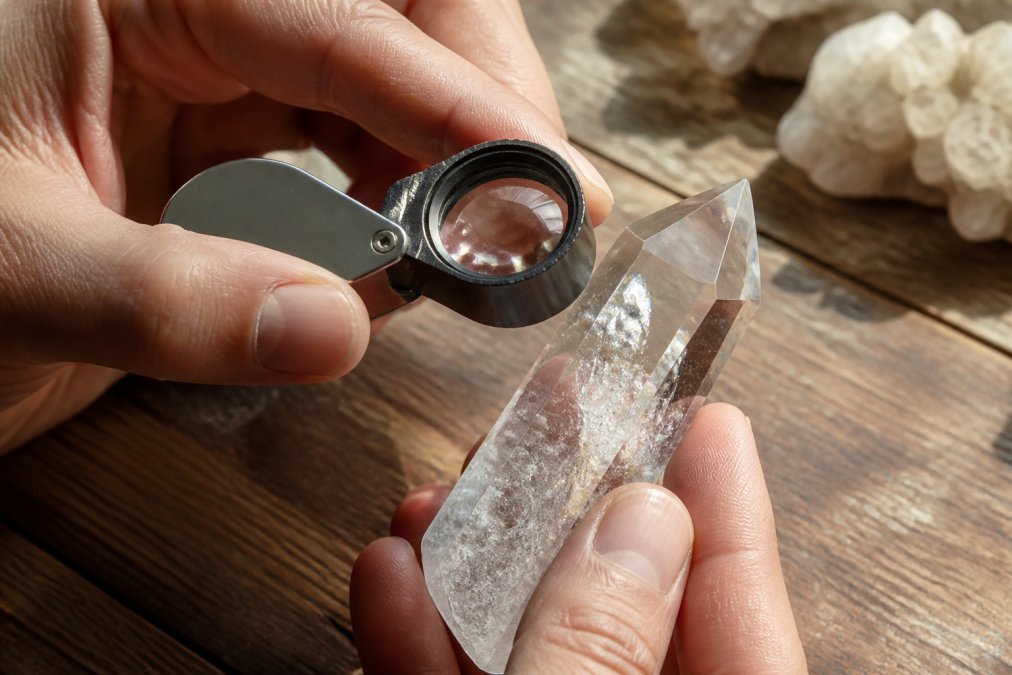
Using a Jeweler's Loupe for Microscopic Analysis
Hold the loupe close to your eye, then bring the crystal toward it until it snaps into focus. Keep the stone about an inch from the lens and brace both elbows on a table so the image stops swimming. Look for three things: cleavage planes (flat, parallel internal surfaces), conchoidal fracture (curved, shell-like breaks typical of glass), and crystal structure at the surface.
- Bubbles. A single round gas bubble is the classic tell of glass or resin. Natural crystals can trap fluid inclusions, but those look angular, elongated, or clustered, not like a perfect sphere.
- Growth lines. Natural crystals show fine, parallel striations that run in one consistent direction across a face. Glass has none. Lab-grown crystals can show curved striations instead of straight ones.
- Color zoning. Natural amethyst, for instance, often shifts from deep purple at the tip to nearly clear at the base. Uniform color from tip to base is a synthetic or dyed signal.
- Surface pitting. Natural stones show tiny pits, abrasions, and growth hillocks. A molded fake has a smooth, almost waxy surface with no wear.
- Mold seams. A faint raised line running around the stone is a dead giveaway for a cast piece.
What Different Minerals Actually Look Like Under 10x
Generic advice only goes so far. The inclusions you should expect vary by species:
- Quartz and amethyst: look for rutile needles, chlorite flecks, or two-phase fluid inclusions. Perfectly clean, water-clear quartz with zero inclusions is more often lab-grown than mined.
- Citrine: natural citrine is pale yellow to smoky gold and rarely shows the deep orange of heat-treated amethyst. Under the loupe, heat-treated material often shows fine internal fissures from thermal shock.
- Rose quartz: natural material is almost always cloudy or fractured. A transparent, flawless pink stone is usually glass.
- Selenite: natural selenite shows fine parallel growth lines and a fibrous internal structure. Molded selenite substitutes look like smooth plastic rods.
2. How to Tell If a Crystal Is Glass or Plastic
Glass and plastic imitations are the most common fakes on the market, and both fail simple physical tests. Glass feels cold initially but warms quickly in your hand. Plastic never feels cold at all. Real crystal holds temperature longer because of its thermal conductivity, which is a measurable physical property, not a feeling.

The Temperature and Thermal Conductivity Check
For a more reliable read, place the stone in a cool room for fifteen minutes, then pick it up. Natural stones absorb and hold coolness; glass and resin equalize to room temperature fast. Thermal conductivity in real minerals like quartz and amethyst is high, meaning heat moves through them quickly, which is why they feel cold to the touch.
3. Hardness, Weight, and Density: The Mohs Scale in Practice
The Mohs hardness scale ranks minerals from 1 (talc) to 10 (diamond), and it is the backbone of mineral identification. Quartz sits at 7. Glass sits around 5.5. That gap matters: a real quartz point will scratch glass, while a glass imitation cannot scratch itself.
| Test | What It Detects | Risk to Specimen |
|---|---|---|
| Visual inspection | Inclusions, surface texture | None |
| Temperature check | Glass, plastic, resin | None |
| Mohs scratch test | Hardness, material type | Low (base only) |
| Weight and density | Resin, plastic fakes | None |
| UV light test | Dyes, heat treatment | None |
| Loupe inspection | Growth patterns, fractures | None |
4. UV Light, Fluorescence, and Heat-Treated Crystals
A UV light test exposes treatments that are invisible under normal light. Some natural stones fluoresce under ultraviolet light; dyed stones and resin-based fakes often glow in ways natural minerals do not. Hold your 365nm light a few inches from the stone in a darkened room and watch for color shifts.
5. Are Heat Treated Crystals Less Effective?
No, heat-treated crystals are not less effective for most spiritual or energetic uses. The treatment changes color and appearance, not the mineral itself. A heat-treated amethyst is still amethyst at the crystal lattice level.
Selenite Charging Plate – Lotus Flower →
6. Ethical Crystal Sourcing Practices: Beyond Authenticity
Authenticity and ethics are separate questions, and most guides only answer the first one. A stone can be 100% natural and still come from a supply chain with serious labor concerns. Ethical crystal sourcing practices require asking where a stone was mined, who mined it, and whether the seller can trace it.
Ask suppliers three questions:
- Which country and region was this stone mined in?
- Can you name the mine or supplier relationship?
- Are workers paid fairly and is child labor excluded from the supply chain?
7. Destructive vs. Non-Destructive Testing: What to Avoid
Non-destructive testing should always come first. Visual inspection, the temperature check, UV fluorescence, and loupe analysis all leave your crystal untouched. These four tests alone resolve the majority of authenticity questions.
Sort Every Test by Risk Before You Touch the Stone
Most guides hand you a list of tests and let you figure out the consequences. That is how people ruin good specimens. Sort each method into one of three tiers first:
| Tier | Tests | What It Costs You If You Are Wrong |
|---|---|---|
| Zero risk | Visual inspection, loupe analysis, UV light, weight and density, temperature check | Nothing, repeat as often as you like |
| Low risk (inconspicuous area only) | Mohs scratch test on the base or a hidden facet, streak test on unglazed porcelain | A small permanent mark on a surface nobody sees |
| High risk (avoid at home) | Acid tests, flame testing, hot-water thermal shock, fracture or cleavage tests, scratching visible display faces | Cracks, clouding, color loss, or a broken specimen |
Sequence Your Tests Cheapest and Safest First
Run them in this order and stop as soon as you have your answer:
- Loupe inspection, free, instant, catches most glass and resin fakes.
- Temperature check, free, catches plastic and resin immediately.
- Weight and density comparison, free if you own a scale, catches lightweight fakes.
- UV light, catches dyes and some treatments.
- Mohs scratch on the base, only if the first four are inconclusive and you accept a small mark.
- Professional lab referral, for anything with real value.
When to Stop Testing and Pay a Professional
If a stone is worth more than a few hundred dollars, or if you plan to resell it, the cost of a gemologist's report is almost always cheaper than the cost of a botched home test. A credentialed gemologist can measure refractive index, specific gravity with precision instruments, and optical character, data no loupe or scratch test can produce. Ask for the report in writing, and confirm the gemologist is independent of the seller.
Frequently Asked Questions
How to check authenticity of crystals?
Start with a visual inspection using a jeweler's loupe to look for natural inclusions and surface texture. Then try the temperature test: real crystals feel cold and warm slowly in your hand, while glass and plastic warm quickly. A UV flashlight can reveal fluorescence in some stones. For deeper verification, check weight and hardness against the Mohs scale. No single test is perfect, so combine at least three methods before deciding.
How to tell if a crystal is real with a flashlight?
Use a UV flashlight in a dark room. Some natural crystals like fluorite and amber fluoresce under UV light, while many glass imitations do not. A regular flashlight held behind a stone can also show internal fractures, bubbles, or growth patterns. Round air bubbles usually mean glass or resin. Natural inclusions like matrix or crystal lattice lines are a good sign of authenticity.
What are the signs of a heat-treated crystal?
Heat-treated crystals often show unnatural color saturation, especially in amethyst turned citrine or dyed agate. Look for color concentrated in fractures or uneven patches rather than throughout the stone. Heat treatment can also create a glossy, almost plastic-like surface. Ask sellers directly about treatment, and check for lab-grown or synthetic growth patterns under magnification.
How do I know if my crystal was ethically sourced?
Ask the seller for details about their supply chain, including the mine or region of origin and whether they work directly with miners. Ethical crystal sourcing practices include fair wages, safe working conditions, and environmental protections. Look for transparency in pricing and real photography of the actual stones. Reputable sellers like MyLee Moon Blessings provide honest sourcing information and can explain how their crystals are cleansed and handled before shipping.