

Are Crystals Mined in the USA Ethical?
Last Updated: October 24, 2026
Quick Summary
Are crystals mined in the USA ethical? It depends on the mine, the operator, and the rules they follow, since no single label covers every American stone. US-mined crystals are generally easier to trace and operate under stronger labor-law floors, but they are not automatically more ethical or sustainable.
- Ethical sourcing focuses on fair labor and safe conditions; sustainable sourcing focuses on land and water impact.
- US crystals can come from federal claims, state leases, private land, or fee-dig sites, each with different records.
- Ask sellers for the mine name, county, land status, and extraction method in writing.
- The General Mining Law of 1872 allows claim staking with limited environmental review and no federal royalty for many minerals.
- Collecting, fee-digging, and commercial mining carry minimal, small, and significant environmental footprints respectively.
Table of Contents
- What Ethical Sourcing Means for Crystals Mined in the USA
- How to Verify Crystal Origins Before You Buy
- Questions to Ask Crystal Sellers About Sourcing
- Ethical Crystal Mining Practices and the Limits of Certification
- Crystal Mining Environmental Impact: Domestic vs. Imported
- Labor Conditions, Child Labor, and Supply-Chain Transparency
- Collecting, Fee-Digging, and Commercial Mining: Three Different Footprints
- Choosing Crystals You Can Feel Good About
- Frequently Asked Questions
What Ethical Sourcing Means for Crystals Mined in the USA
Are crystals mined in the USA ethical? The honest answer is: it depends on the mine, the operator, and the rules they follow.
Ethical sourcing is the practice of tracing a crystal from the ground it came from to the seller's hands, while confirming fair labor, safe working conditions, and land care at every step.
That definition sounds simple. Living up to it is where things get complicated.
Ethical vs. Sustainable: A Distinction That Matters
Ethical sourcing focuses on people: fair wages, safe working conditions, and no child labor. Sustainable sourcing focuses on the land: water use, habitat disturbance, and how a site is restored after mining ends.
A crystal can be ethical without being sustainable, and the reverse. A small family claim that pays fair wages but leaves an unreclaimed pit is one example.
How to Verify Crystal Origins Before You Buy
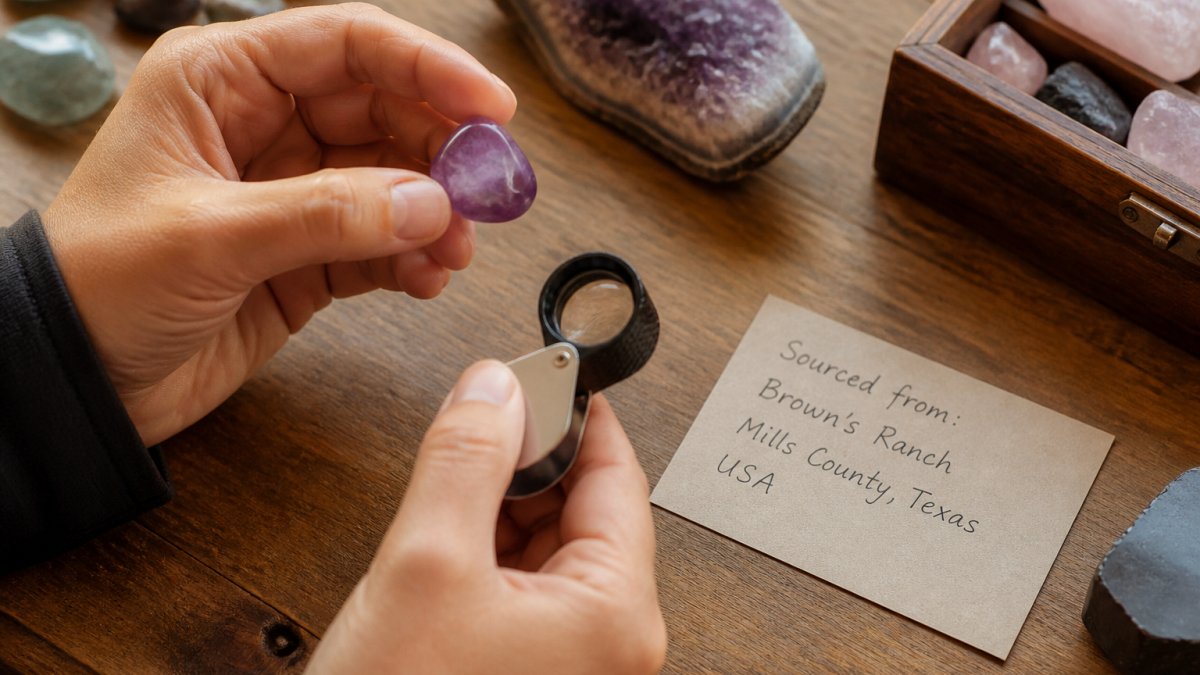
Verification starts with asking the seller for specifics, not assurances. A seller who can name the mine, the region, and the extraction method is giving you something checkable. But for stones claimed as US-mined, the checkable details are different from what you would ask about an imported stone, because US mining happens under a patchwork of land status, claim types, and state rules.
Why US Origin Is Harder to Verify Than It Sounds
A crystal labeled "mined in the USA" could come from at least four very different settings, and each one leaves a different paper trail:
- A federal mining claim under the General Mining Law of 1872. Claims are recorded, but the law does not require royalty payments or comprehensive environmental review for many locatable minerals, so a valid claim is not proof of responsible practice.
- State-leased land, where permits and reclamation bonds are set by the state agency, and those requirements vary widely from one state to another.
- Private land, where the owner controls access and there may be no public permit record at all.
That means "US-mined" is a starting point, not a verification. The useful question is: which of these settings produced this stone, and what records exist for it?
A Practical US-Origin Verification Checklist
Use this list when a seller claims a crystal was mined domestically. The first four items are the ones most sellers cannot answer, which is exactly why they matter:
- Mine name, county, and state of origin given in writing
- Land status named: federal claim, state lease, private land, or fee-dig site
- Extraction method described: surface collecting, fee-digging, or commercial operation
A seller who clears most of this list is worth a conversation. One who dodges every item is not.
What Public Records Can and Cannot Tell You
You can often check whether a mining claim exists through public land-records systems, and state agencies publish some permit and reclamation information.
That is the honest limit of US-origin verification: you can confirm that a mine and a claim exist, and you can sometimes confirm the operator, but you cannot confirm labor conditions from a database.
Our guide on how to verify authentic crystal origin walks through seven tests you can run before spending money.
Questions to Ask Crystal Sellers About Sourcing
Ask about the mine first, then the workers, then the land. Specific questions get specific answers, and vague ones get marketing copy.
Try these:
- Which mine did this stone come from, and who operates it?
- How are workers paid, and are they hired directly or through contractors?
- What happens to the site after extraction?
If you want a fuller checklist of ethical-sourcing signals, our article on signs of ethically sourced healing crystals breaks down what strong answers look like.
Ethical Crystal Mining Practices and the Limits of Certification
There is no single certification that covers every crystal on the market. Some stones carry chain-of-custody documentation; most do not. Industry-wide standards for gemstone and mineral traceability remain uneven, and independent verification is the exception rather than the rule.
This is the part most buyers miss. A certificate proves a claim was checked by someone. It does not prove the claim is complete.
Responsible purchasing means reading the claim, asking what it covers, and accepting that some gaps cannot be closed. Our explainer on why ethically sourced crystals cost more covers the real costs behind verified sourcing and why the price gap exists.
Crystal Mining Environmental Impact: Domestic vs. Imported
Environmental impact depends on the site, not the passport. A commercial pegmatite operation in the US disturbs land, uses water, and generates waste rock just as an overseas mine does. The difference lies in regulation, enforcement, and how much of the supply chain you can actually see.
Zodiac Crystal Set | 4 Tumbled Stones for Your Astrological Sign | Ethically →
The US Regulatory Patchwork, in Plain Terms
There is no single federal rulebook for crystal mining. What applies depends on who owns the land and what is being extracted:
- Federal land: Many hardrock minerals are still governed by the General Mining Law of 1872, which allows claim staking with limited environmental review and no federal royalty for many locatable minerals. That is a very different framework from coal or oil and gas.
- State land and state rules: Reclamation requirements, water-use permits, and bonding are set at the state level. A state with strong reclamation bonding and inspection capacity produces a different footprint than a state with minimal staffing.
- Private land: The owner sets access terms, and oversight may be limited to general water and waste rules rather than mining-specific permits.
What Actually Differs Between Domestic and Imported Stones
Rather than declaring one origin better, compare them on four concrete dimensions:
- Traceability. Domestic supply chains are usually shorter, which makes it easier to name the mine. That makes verification simpler, not automatic, a short chain can still be an undocumented one.
- Labor risk. US commercial operations fall under federal and state labor law, which sets a higher floor for worker safety than many artisanal operations abroad. Small fee-dig and collecting sites operate under different rules, and enforcement varies.
- Environmental oversight. US operations face reclamation and water rules that many producing regions abroad do not, but the 1872 framework and uneven state enforcement mean "US-mined" is not a guarantee of strong environmental outcomes.
- Transport and energy. Imported stones carry shipping emissions and often pass through multiple dealers, which adds both carbon and opacity. Domestic stones usually travel less, but a short trip does not offset a poorly run mine.
The Honest Comparison
The evidence supports a narrow claim, not a broad one: US-mined crystals are generally easier to trace and generally operate under stronger labor-law floors, but they are not automatically more ethical or more sustainable.
A domestic stone with a named mine, a described extraction method, and a documented chain of custody beats an imported stone with none of those things.
Labor Conditions, Child Labor, and Supply-Chain Transparency
Labor risk exists everywhere, but it looks different by region. The International Labour Organization's work on child labour in mining documents these patterns across producing regions.
US commercial operations fall under federal and state labor law, which sets a higher floor for worker safety than many artisanal operations abroad.
Supply-chain transparency is where buyers have use. A seller who can name the mine and the middlemen is a seller who has done the tracing work.
Collecting, Fee-Digging, and Commercial Mining: Three Different Footprints
These three activities get lumped together, and they should not be.
Collecting means picking up surface stones on private land with permission. Footprint: minimal.
Fee-digging means paying a site owner for access to dig.
Commercial mining means extracting at scale for sale.
A tumbled stone from a fee-dig site and one from a commercial mine carry different environmental histories.
The article separates three activities that are often lumped together, each with a different footprint.
| Activity | What it means | Footprint |
|---|---|---|
| Collecting | Picking up surface stones on private land with permission | Minimal |
| Fee-digging | Paying a site owner for access to dig | Small but real; repeated digging disturbs soil and vegetation |
| Commercial mining | Extracting at scale for sale | Significant; land disturbance, water use, waste management obligations |
Choosing Crystals You Can Feel Good About
Start with sellers who volunteer sourcing details before you ask. That single habit filters out most of the vague claims.
At MyLee Moon Blessings, every stone we sell is ethically sourced, hand-selected, and cleansed and charged with intention before it ships. Our Zodiac Crystal Set pairs four tumbled stones with your astrological sign for $15.00, and our Rose Quartz Tumble starts at $1.50 for a pocket-sized Heart Chakra stone. If you are ready to buy, our guide on whether it is safe to buy crystals online covers what to check before checkout, and our list of ethically sourced crystal towers gives you ten options to start with.


The question of whether crystals mined in the USA are ethical has no blanket answer. It has a process: ask, verify, and buy from sellers who welcome the questions.
Frequently Asked Questions
Are crystals mined in the USA more ethical than imported crystals?
Not automatically. Domestic mining operates under state and federal rules, but enforcement varies by state and small operations can still disturb land or water. Imported stones can be ethical too when the seller discloses the mine, the country of origin, and the conditions under which the material was extracted. The real difference is traceability: a US seller is easier to question directly, and state regulators are easier to check. Ask for a mine name and location before assuming domestic means responsible.
How can I tell where a crystal was mined?
Start with seller disclosure. A transparent seller can name the mine, the region, and roughly when the material was extracted. Look for chain-of-custody details: who bought the rough, who cut and polished it, and whether any documentation travelled with it. Independent verification is rare in this industry, so treat a specific, consistent answer as a better signal than a generic ethically sourced label. If the origin changes every time you ask, that is your answer.
What questions should I ask a crystal seller about sourcing?
Ask four things: which mine and country the stone came from, whether the seller has visited or has a direct relationship with that supplier, how workers are paid and protected, and what happens to the land and water after extraction. Then ask for evidence, such as photos, supplier names, or a written sourcing policy. A seller who answers specifically and consistently is showing you more than one who repeats a certification logo without detail.
Can small-scale crystal mining be ethical?
It can, and artisanal and small-scale mining is where many ethical claims are built. The risks are labor conditions, fair wages, and land rehabilitation, which are harder to monitor at small sites. Ethical small-scale operations tend to have direct buyer relationships, clear payment terms, and a plan for restoring disturbed ground. Ask how the site is reclaimed and how workers are compensated, not just whether the operation is small.
What environmental impact does crystal mining have?
Crystal mining can cause land disturbance, habitat loss, water pollution from runoff and sediment, and waste rock that is never rehabilitated. The severity depends on scale and method: hand collecting and fee-digging leave a light footprint, while commercial operations move far more material. Ask sellers whether the site has a rehabilitation plan and whether water management is in place. Those two answers tell you more than a sustainability badge.
Sourcing transparency should not require detective work. At MyLee Moon Blessings, we hand-select every stone, cleanse and charge each piece before shipping, and photograph the actual crystal you receive so there are no surprises. Start with a Zodiac Crystal Set or a single Rose Quartz Tumble, and shop with the confidence that comes from honest sourcing.
