

7 Ways to Tell If Amethyst Is Real or Fake
Last Updated: October 28, 2026
Quick Summary
To tell if amethyst is real or fake, backlight the stone and inspect it with a 10x jeweler's loupe: real amethyst shows uneven color zoning and natural inclusions, while fake glass shows round air bubbles, swirl lines, and flat even color. Decide real or fake before money changes hands.
- Real amethyst almost never has a single, flat shade of purple.
- A 10x jeweler's loupe costs about $10 to $20 at any jewelry-supply counter.
- Never scratch a finished, polished, or jewelry-set piece, since a visible scratch ruins resale value.
- Quartz has a specific gravity around 2.65, so real amethyst feels lighter than glass of the same size.
- Heat-treated amethyst is still real amethyst, while glass or plastic imitation is genuinely fake.
Table of Contents
- Start With the Fake Amethyst Signs You Can Spot in Seconds
- Amethyst Glass vs Real Amethyst: How to Tell Them Apart
- The Amethyst Scratch Test and the Mohs Hardness Scale
- Temperature, Weight, and the Cold-to-the-Touch Check
- UV Light Fluorescence and What It Reveals
- Stones Mistaken for Amethyst and How to Rule Them Out
- Synthetic vs Heat-Treated: What Still Counts as Real
- Shop Amethyst Pieces That Arrive Verified and Cleansed
- Frequently Asked Questions
Start With the Fake Amethyst Signs You Can Spot in Seconds
Learning how to tell if amethyst is real or fake starts with one habit: slow down and look closely before you buy, and decide real or fake before money changes hands. A genuine piece has depth and variation.
Color That Looks Too Even to Be Natural
Real amethyst almost never has a single, flat shade of purple.
Bubbles, Seams, and Other Giveaways
Air bubbles are the tell. Glass imitation amethyst forms round bubbles during manufacturing, and they stay trapped inside. Natural quartz can contain bubbles too, but they are irregular, tiny, and often arranged in lines or clouds. Round, perfectly spherical bubbles, especially clustered near the surface, mean glass. Look for seams and mold lines as well, plus any surface that feels slick and warm rather than cool. A jeweler's loupe makes these details obvious in seconds.
Amethyst Glass vs Real Amethyst: How to Tell Them Apart
The quick answer: real amethyst is a crystalline form of quartz with internal structure, and glass is a manufactured solid with none. But "look for bubbles" is where most guides stop, and that is exactly where buyers get fooled, plenty of glass imitations are clean enough that you will not see a bubble with the naked eye. The reliable method is a short, ordered protocol using a 10x jeweler's loupe, which costs about $10-$20 at any jewelry-supply counter and is the single most useful tool in this article.
The 60-Second Loupe Protocol
- Backlight the stone. Hold it against a phone flashlight or a window. Real amethyst transmits light unevenly because color zoning and internal fractures bend the light; glass transmits it in a flat, even wash.
- Look for the pour line. Glass is cast or molded, so a loupe often reveals a faint wavy flow line or swirl, a thin, curved ribbon of slightly different density. Quartz never shows this; its internal lines are straight fracture planes or crystal faces.
- Check the bubbles. Under 10x, glass bubbles are perfectly round and often clustered in a line or near the surface where the mold cooled. Natural quartz can contain two-phase inclusions (a tiny bubble inside a liquid-filled cavity), but those look irregular and are usually isolated, not lined up like beads.
- Hunt for crystal faces. A rough or partially polished piece of real amethyst shows flat, planar faces meeting at consistent angles, the crystal habit. Glass has only the shape of its mold: smooth, rounded, or with a seam where two mold halves met.
- Inspect the surface wear. Glass chips in curved, conchoidal flakes that look like broken bottle glass under the loupe. Quartz chips along fracture planes and shows tiny step-like breaks.
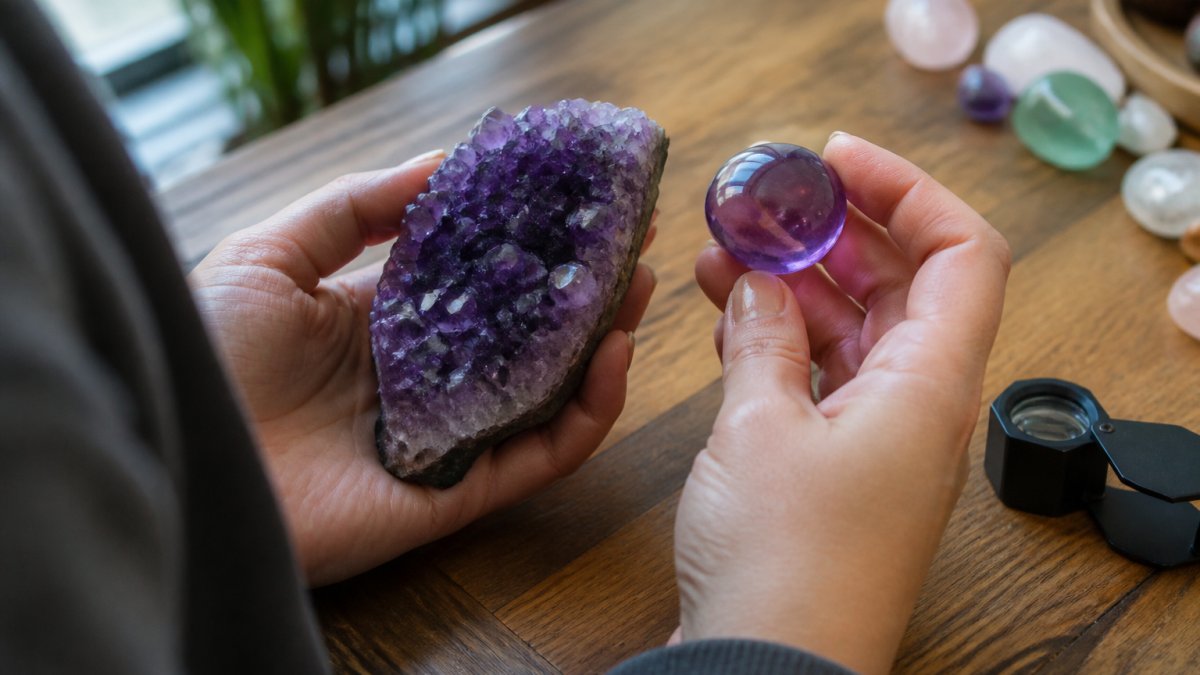
What the Loupe Reveals That the Naked Eye Misses
At 10x, natural amethyst typically shows a scatter of tiny mineral inclusions, rutile needles, iron-oxide specks, or faint "fingerprint" fluid inclusions that look like a smudged thumbprint inside the stone. These are the strongest single indicator of natural origin, because they cannot be manufactured economically. Glass imitations are usually too clean: uniform, empty, and glassy all the way through. A stone that looks perfect under a loupe is more suspicious than one with a few visible flaws.
Weight and Warmth as a Backup Check
If you want a broader method beyond amethyst, our guide on how to spot fake crystals walks through the full checklist.
The Amethyst Scratch Test and the Mohs Hardness Scale
Watch out: never scratch a finished, polished, or jewelry-set piece. A visible scratch ruins resale value and can chip a facet. Test rough specimens or the base of a cluster instead, and when in doubt, skip the scratch and use a jeweler's loupe.
Here is how the common materials stack up:
| Material | Mohs Hardness | Scratched by Steel? | Typical Giveaway |
|---|---|---|---|
| Real amethyst | 7 | No | Color zoning, natural inclusions |
| Glass imitation | ~5.5 | Yes | Round air bubbles, swirl marks |
| Dyed quartz | 7 | No | Dye pooled in fractures |
| Plastic or resin | 2-3 | Yes, easily | Warm to touch, feels light |
Temperature, Weight, and the Cold-to-the-Touch Check
Specific gravity gives you a second check. Quartz has a specific gravity around 2.65, so a real piece feels lighter in the hand than a glass piece of the same size. Plastic feels noticeably light and almost hollow. Combine all three signals, cold, weight, and luster, and you have a solid read before you ever pull out a loupe.
Raw Amethyst Cluster 2-2.5" | Purple Crystal for Anxiety Relief & Deep Sleep →
UV Light Fluorescence and What It Reveals
A cheap UV flashlight is enough. Take the stone into a dark room and shine the light across it. A strong, even glow is a reason to look harder at the piece. No glow is not proof of authenticity, but combined with color zoning and cold-to-the-touch feel, it builds a confident picture.
Stones Mistaken for Amethyst and How to Rule Them Out
Ruling them out comes down to hardness, color zoning, and internal structure. Fluorite scratches easily and often fluoresces strongly under UV. Dyed agate shows unnatural color in its bands and dye pooling at the edges. Once you have eliminated the lookalikes, the next step is confirming origin and natural state, which our guide to verifying authentic crystal origin covers test by test.
Synthetic vs Heat-Treated: What Still Counts as Real
- Glass or plastic imitation is not amethyst at all. It is a manufactured solid with no quartz structure. This is the only category that is genuinely fake.
- Heat-treated amethyst is natural quartz that was heated to shift its color, often to deepen the purple, and sometimes all the way to citrine or prasiolite. Heat treatment is common, widely accepted in the trade, and generally stable. It is still real amethyst; it has simply been altered.
- Lab-grown (synthetic) amethyst is quartz with the same chemical formula as natural amethyst, grown in a lab rather than in the earth. It is chemically identical, so hardness, specific gravity, and cold-to-the-touch tests will not separate it from natural stone. It is real quartz but not natural amethyst, and it should be labeled as lab-grown.
How to Tell Them Apart in Practice
- Ask for the disclosure in writing. Reputable sellers state natural, heat-treated, or lab-grown on the listing or receipt. A seller who cannot answer clearly is telling you something. Under the FTC's Jewelry Guides, marketers are expected to disclose treatments that significantly affect value, so a vague answer is a red flag, not a courtesy gap.
- Look at the color distribution. Natural amethyst almost always shows color zoning, bands, smoky patches, or a paler base near the termination. Lab-grown material tends to be more uniformly colored because it grew under controlled conditions. Heat-treated natural stone usually keeps its zoning but may show a slightly "cooked" evenness in the darkest areas.
- Check the price against the size. A large, flawless, deeply colored amethyst at a fraction of the going rate is usually lab-grown or glass. Natural amethyst in that size and clarity commands a premium; if the price does not reflect it, ask why.
- Use UV as a weak filter, not a verdict. Under a UV flashlight, many natural amethysts show little to no fluorescence, while some synthetics and dyes glow noticeably. A strong, even glow is a reason to look harder, but no glow does not prove natural origin, because heat-treated and lab-grown stones can also be quiet under UV.
- Look for certification on higher-value pieces. For anything above a casual purchase, a report from a recognized gemological lab is the only definitive answer on origin and treatment. Ask which lab and read the report yourself rather than trusting a seller's summary.
Why the Distinction Matters to Your Wallet
Natural, untreated amethyst carries a premium because it is rarer in fine color and size. Heat-treated natural stone is priced closer to untreated natural but should be disclosed. Lab-grown material is typically the least expensive of the three and should be priced accordingly. If you are paying natural-untreated prices, you are entitled to natural-untreated disclosure. For the full breakdown, read our guide on identifying heat-treated crystals and our buyer's guide to heat-treated vs natural amethyst.
Shop Amethyst Pieces That Arrive Verified and Cleansed
At MyLee Moon Blessings, crystals are energetically cleansed before shipping, and the business provides real photography. Our standing amethyst cluster with a cut base is a Uruguayan or Brazilian specimen.

When you are ready for a piece that arrives cleansed, browse the MyLee Moon Blessings amethyst collection and choose the specimen that calls to you.
Frequently Asked Questions
Can fake amethyst pass a scratch test?
Glass and plastic imitations usually fail it. Amethyst sits at 7 on the Mohs hardness scale, so it scratches glass (around 5.5) rather than the other way around. A steel file or knife blade will not mark genuine amethyst either. The catch is that synthetic quartz is chemically identical to natural amethyst and will pass every scratch test, so use this check alongside color zoning, inclusions, and temperature rather than on its own.
Does amethyst glow under UV light?
Most natural amethyst stays dull or shows only faint fluorescence under ultraviolet light. Strong, bright glow is more common in dyed or synthetic material, and some glass imitations light up vividly. A dull result does not prove authenticity on its own, since fluorescence varies by origin, but a stone that glows intensely is worth a closer look with a loupe before you buy.
What stones are commonly mistaken for amethyst?
Purple fluorite, dyed quartz, purple glass, and synthetic quartz are the usual mix-ups. Fluorite is softer (4 on the Mohs scale) and often shows banded color, while dyed quartz shows color concentrated in cracks. Purple sapphire and spinel exist but are far rarer and priced well above amethyst. If the color looks violet-blue rather than purple and the price is unusually high, ask for a gemological report.
Is heat-treated amethyst still real amethyst?
Yes. Heat treatment changes the color, often turning amethyst into citrine or lightening it, but the material remains natural quartz from the quartz family. It is not the same as synthetic amethyst, which is grown in a lab. Reputable sellers disclose treatment, so ask directly. At MyLee Moon Blessings, each amethyst piece is a natural formation photographed as it is, so what you see is what arrives.
How can I tell if amethyst is real by looking at it?
Look for uneven color. Natural amethyst usually shows color zoning, with deeper purple concentrated near the tips or in bands, plus natural inclusions and thread-like fractures. Perfectly uniform color with no internal features points toward glass or dye. Hold it to the light: real amethyst shows translucency and a vitreous luster, while glass often reveals tiny round air bubbles. A jeweler's loupe makes these details easy to see.
